Before the Postcard: How the Village Green Became Common Ground
Learn how the village green became common ground, and see how grazing, gatherings and everyday crossings shaped its familiar place in village life.
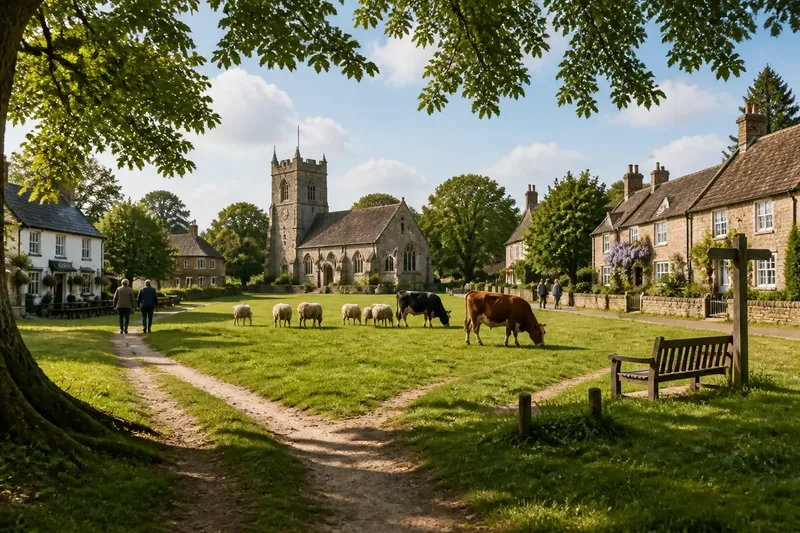
A village green can look like a simple patch of grass beside a church, pub or row of houses. Yet its familiar place in village life grew from a more practical idea: an open space that different people could use, in different ways, as part of the ordinary business of living together.
To understand the green before it became a postcard view, it helps to look at the layers of use that gathered around it. These seven features explain how shared work, local custom and everyday movement helped make an open space feel like the centre of a village.
1. A village green began as useful open ground
In many villages, open ground was valuable because it served needs that a private garden or field could not. Residents might bring animals to graze, gather fuel or make use of routes that crossed the settlement. The precise rights varied from place to place, but the broad principle was that some land was treated as a shared resource rather than as one household’s enclosed plot.
That distinction mattered in a landscape increasingly divided by hedges, walls and ownership boundaries. A green offered room for activities that depended on access, and its usefulness could be more important than its neatness. A worn track or grazed edge was not necessarily damage; it might be evidence of how the space functioned.
Imagine a village where a strip of grass lies between cottages and a lane. If residents bring livestock there and pass across it on their way to fields, the strip becomes part of daily work as well as a route. The expected visible result is a space with several informal paths and a character shaped by repeated use, not a formally designed lawn.
2. Shared grazing tied the green to household routines
Where local custom allowed animals to graze, the green connected village households to the land around them. It could provide access to pasture for people whose own holdings were limited, while making the care of animals part of the village’s shared rhythm. The right to use a space was not the same as unrestricted use: local rules and practical limits could determine who brought animals and when.
Grazing also made the green visibly changeable. Its condition depended on the season, the number and type of animals, and the ground itself. That is a different sort of landscape from a decorative lawn, which is usually expected to look much the same from one visit to the next.
For a visitor today, old boundaries and surviving place names can hint at this working past, although they do not prove exactly how a particular green was used. A map, local history display or conversation with a village heritage group may help distinguish a documented custom from a plausible guess.
3. Paths made the green part of the village’s daily map
People did not only arrive at a green to stay there. Paths across or around open ground could connect homes with a church, well, fields, meeting place or neighbouring lane. A space crossed on foot becomes familiar through repetition: people learn where the surface stays firm after rain, which corner is muddy, and where a gate opens onto a useful route.
That movement helped give the green a central role without requiring it to sit at the exact geographical centre. It could be central in the practical sense that several journeys met there. Like a shared table in a busy kitchen, it gave different errands a common point without making them all the same.
Routes could also change as buildings, roads and boundaries changed. A path that once served farm work might later be used for school, worship or a walk to the shop. The green’s place in village life was therefore not fixed by one original purpose; it could persist because people kept finding ways through it.
4. Markets and gatherings gave the open space a public role
Open ground could provide room for gatherings that were difficult to hold in a narrow street or small building. Depending on local custom, a green might host a market, fair, public meeting, game or seasonal celebration. Such uses brought people together for exchange and entertainment, but also made the space a visible setting for village decisions and shared occasions.
A market or fair had a practical effect on how the place was understood. Stalls, visitors and passing sellers temporarily changed the green from a route or grazing area into a destination. Once the event ended, the ordinary uses returned, leaving the same ground to serve a different purpose on another day.
Not every village green held every kind of event, and present-day traditions should not be projected backwards without evidence. The useful point is that open shared space could accommodate uses that were occasional as well as daily. Its flexibility made it suitable for a crowd without requiring a permanent building.
5. Recreation grew alongside work, not instead of it
Village greens are often pictured as places for games, but recreation was only one part of their story. Children might play where adults passed on errands; neighbours might talk while keeping an eye on animals; a gathering could mix work, watching and leisure. The same patch of ground could be useful and sociable at once.
This overlap helps explain why the green could become emotionally familiar. A person might remember it through a regular walk, a game with friends or a conversation after a service, while another might associate it with livestock or a market day. Shared spaces collect different memories because people use them at different ages and for different reasons.
Say a present-day village uses its green for an annual community gathering while a footpath skirts the edge. If organisers keep a clear route open and residents continue to cross the space on ordinary days, the event and the everyday journey can both remain part of its life. The expected observable result is not a single use replacing another, but a green that still serves more than one group.
6. Local rules helped make common use workable
Shared ground can invite disagreement. Someone may want to graze animals, another may need a clear route, and a third may care for the surface or nearby trees. Local customs and rules helped define what counted as fair use, even if those arrangements were not identical across villages.
Rules could concern access, grazing, maintenance or particular activities. They matter because a common space is not simply land with no owner or no boundaries. It is land whose use is shaped by relationships, obligations and decisions about who may do what.
Today, a green’s legal status and permitted uses can differ considerably. If you plan an event or want to know whether a route is public, check the local authority’s information or ask a qualified local adviser where the question has legal consequences. For a casual visit, signs and visible paths are useful starting points, but they are not a substitute for checking access rights when those rights matter.
7. The postcard view came after the working landscape
The familiar image of a green framed by cottages and a church captures only one moment in a longer story. Grass, trees and buildings can make a pleasing scene, but the green’s significance came from what people did there: crossing, tending animals, gathering, trading and spending time together.
That history is not always visible in a tidy modern space. A maintained lawn may have few traces of grazing, while a surviving path may still follow an older line of movement. Local records, historic maps and parish interpretation can add context, but the landscape itself should be read carefully rather than treated as a complete account.
When you visit, notice the practical clues: where paths meet, which buildings face the open ground, whether a noticeboard records shared events, and how the green connects to lanes beyond it. These details can help you see a village green as common ground rather than merely a scenic foreground.
What do people often ask about village greens?
Were village greens always public parks?
No. Many greens were working or shared spaces before the modern idea of a public park became familiar. Their access and uses depended on local history, custom and rules.
Did every village green allow animals to graze?
No. Grazing is an important part of the history of some greens, but practices differed. Local documents or heritage sources are better guides to a particular place than a general assumption.
Why do some greens have a pond or a broad open centre?
Those features can reflect local geography or past use, but one explanation does not fit every village. Look for a local interpretation panel or ask a village history group before assigning a specific purpose.
Can visitors use a village green for any activity?
Not necessarily. Access, events and permitted activities can depend on local arrangements, signs and rules. For a planned gathering or an activity with legal implications, contact the local authority or another qualified source.
The next time a village green appears to be doing very little, look at the routes, edges and nearby buildings before moving on. Its quiet appearance may sit on top of a long history of shared work and ordinary encounters, and that layered purpose is what made the green feel like the village’s common ground.