How to Choose a Country Loop Walk for Changing Scenery
Choose a country loop walk with clearer navigation and varied ground, so each stretch offers a fresh setting without making the route hard to follow.
Which country loop walk will give you something new to notice without leaving you guessing at every junction? Start by comparing the route’s distinct settings and the decisions it asks you to make, not just the shape it draws on a map.
What makes a loop feel like more than a circuit?
A route can close neatly on a map and still feel much the same from start to finish. Look for changes in the ground and the way you move through it: a stream crossing, a wooded hollow, a ridge path, then a lane through a village edge.
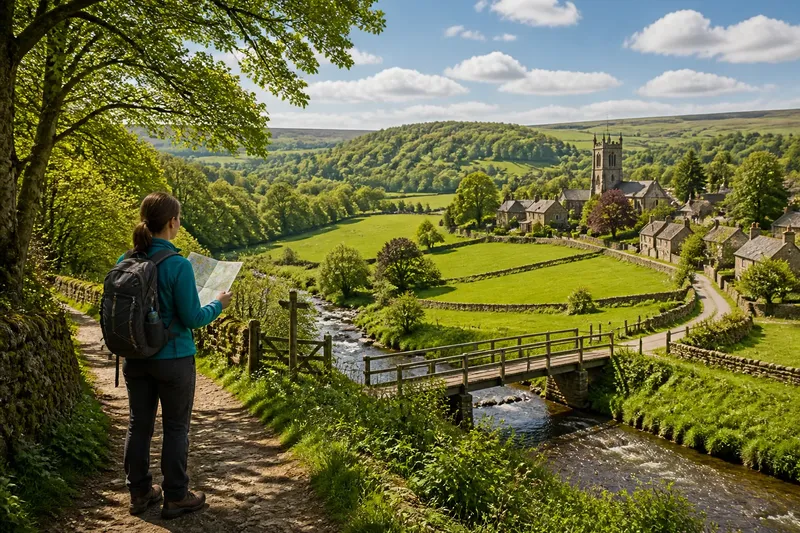
Those transitions give the walk a natural rhythm. A footbridge might mark the move from open fields to riverside shade; a gate onto a lane can bring a different sound and outlook. Choose contrast that fits your group rather than collecting landmarks for their own sake.
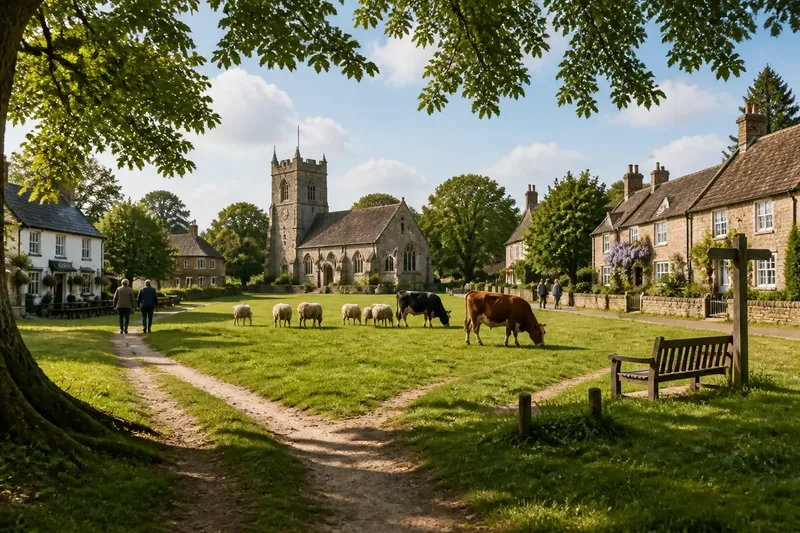
Say you have two printed route descriptions beside you. One follows farm tracks for most of the way; the other starts on a lane, follows a stream, crosses a wooded slope and returns by a village green. If both suit the walkers and conditions, the second offers more distinct settings to look forward to. That is an invented comparison, not a claim about any particular route.
How can you tell whether the directions are clear?
Read the route description as a chain of decisions. A direction such as “take the track after the bridge” is more useful if you can identify which bridge, what the track looks like and what landmark comes next.
Use a current Ordnance Survey map or a reliable local walking guide, and compare its route line with the written directions. Download the map for offline use if you rely on a phone, and carry a paper map if that suits your navigation. Check local access information and signs before walking; the line on a map cannot tell you whether a path is currently diverted or closed.
- Start and finish: If the route begins at a car park or a lane outside the village, confirm how you will reach the starting point; if that link is unclear, choose a circuit with a more obvious start.
- Distinctive turns: If the directions name a bridge, church or woodland edge that appears on your map, use it as a navigation checkpoint; if the landmark is missing or ambiguous, find a route with clearer instructions.
- Surface changes: If the description mentions grass, gravel, mud or a road, decide whether those surfaces suit the group and footwear; if not, choose a route with more comfortable ground.
- Road sections: If the route includes a road walk, check where it begins and ends; if the section seems unsuitable for your party, select a different circuit.
- Access notes: If notices or local guidance describe a closure or diversion, follow that information; if the alternative is unclear, do not try to force the original route.
- Phone and paper maps: If mobile reception may be unreliable, save an offline map or carry a paper one; if you cannot identify your position with the map you have, stop in a safe place and retrace to a recognisable point.
Where does a loop become tiring?
The outline on a map hides what a path asks of your feet. Steep slopes, repeated stiles, soft ground and exposed stretches can make a compact-looking route feel demanding, so read the description for terrain as well as direction.
Consider who is walking and what they are comfortable with. A route with an early, clearly described way back may suit a mixed group better than one where the only return option comes after a confusing junction. If a path is wet or uneven, choose footwear with suitable grip and be willing to leave that route for another day.
Think of the map as a recipe card: it gives you the sequence, but the conditions on the day affect how it works. A route description cannot make slippery ground or a difficult stile easier for someone who would struggle with it.
What if the route looks different on the ground?
Pause at a safe spot rather than picking a track because it points in roughly the right direction. Compare the map with visible features such as a bridge, a field boundary or the shape of a village, then return to the last point you recognised if the route still does not make sense.
If signs, a gate or a path surface differ from the description, check current local information and obey any closure or diversion notice. Do not cross a field, enter private land or pass a barrier simply to keep the circuit intact. A different way back is only useful if it is clear, permitted and suitable for your group.
Which country loop walk questions do people ask?
Is a loop better than walking out and back?
Neither shape is automatically better. A loop can bring changing surroundings, while an out-and-back route may be easier to follow or better suited to the terrain and access available.
Can I walk a circular route in either direction?
Check the route description before choosing a direction. Slopes, crossings or turn-by-turn instructions may make one way clearer or more comfortable than the other.
What should I do if I lose the path?
Stop somewhere safe and compare your map with landmarks you can identify. If you cannot confirm where you are, retrace your steps to the last recognised point rather than pressing on along an uncertain track.
How do I choose a route for a mixed group?
Check the surfaces, slopes, stiles and road sections against what everyone is comfortable walking. Prefer a clearly described route with a known return option if a member of the group may need to shorten the outing.
How do you choose the right loop for your day?
Compare the country loop walk’s landscape changes, route descriptions and ground conditions with the people who will be walking it. A circuit is a good choice when its turning points make sense on the map and its surfaces suit the group, not merely because it returns to where it began.
Before setting off, make sure everyone knows the first landmark and what to do if the route becomes unclear. That small shared reference can make it easier to pause, check the map and choose a permitted way back without turning a pleasant walk into a navigation contest.